“Am I Not Here, I Who Am Your Mother?”
 |
| https://www.infobae.com/america/ |
I
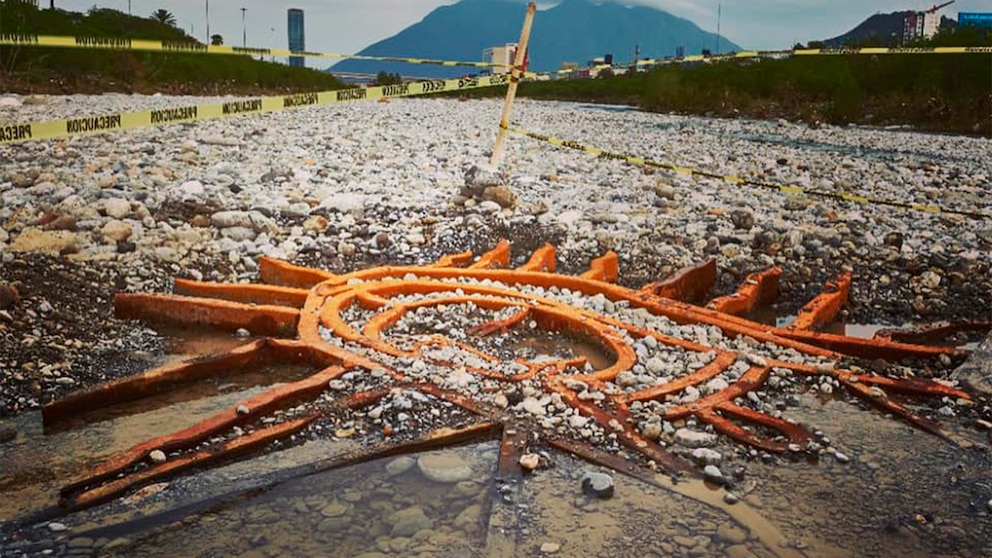
n July 2020, as the world struggled under the weight of a pandemic, something unexpected happened in Mexico. After a decade of being buried under mud and stone, a 40-foot steel statue of Our Lady of Guadalupe was lifted out of the riverbed in Monterrey. It had been lost in 2010 when Hurricane Alex flooded the city. For ten years the image of Mary lay hidden, unseen, forgotten beneath the Río Santa Catarina. But when a storm passed again—Hurricane Hanna in 2020—she rose. Out of the rubble, out of the mud, she was lifted before crowds who rejoiced as if a mother had returned home. And it happened just as Mexico’s Supreme Court rejected a major move to legalize abortion. Many saw in this “resurrection” a message, a sign: Mary had returned again to defend life. She reappeared just when the most vulnerable—our sick, our unborn—needed a mother’s help. Even buried, even forgotten, she came back to say, “I am still here.”
But this is not the first time she has intervened. Long before there was Monterrey, steel statues and before tropical storms were named in alphabetical order, there was a hill called Tepeyac. Before Our Lady of Guadalupe appeared to Juan Diego in 1531, Mexico was ruled by religions of violence. At Teotihuacán—the ancient “city of the gods”—human sacrifice was practiced for centuries. A pyramid dedicated to the Feathered Serpent was decorated with 360 carved serpent heads. Beneath it, archaeologists uncovered bound, decapitated victims who had been offered to these gods. Their blood was thought to sustain the universe. When Mary appeared to Juan Diego, she gave her name in his native language not as Guadalupe, but Coatlaxopeuh—“the one who crushes the serpent.” Not just any serpent, but the feathered serpent, the god of sacrifice and death. She came not only as the Mother of Jesus, but as the Crusher of Violence, the Mother of Life, and the end of human sacrifice.
And she came to a poor man with a dying uncle. Juan Diego found himself torn between three demands: a bishop who refused to believe him, a sick uncle who needed a priest immediately, and a mysterious woman asking for trust. He avoided her, taking another road. And there she met him again. She intercepted him—not to scold, but to comfort. And she spoke the words that changed Mexican history: “Am I not here, I who am your mother? Do not fear any illness or pain.” She did not ask Juan Diego to choose between his uncle or his mission. She reminded him that God provides for all things, even what feels impossible. When he returned home, his uncle was already healed.
As we celebrate St Juan Diego, we may ask ourselves: What part of my life feels forgotten or “buried,” just as Juan Diego felt small and unnoticed, yet chosen by God? Do I sometimes take another road, avoiding what God asks of me because I feel afraid, busy, or unworthy? And how is God inviting me, like Juan Diego, to defend life, to protect the vulnerable, and to trust that He will take care of what I cannot handle?
May Juan Diego’s example remind us that God chooses the humble, strengthens the fearful, and works through the least expected. St Juan Diego, pray for us. Fr JM Manzano SJ

Comments
Post a Comment
Thank you for your interest in the above post. When you make a comment, I would personally read it first before it gets published with my response.