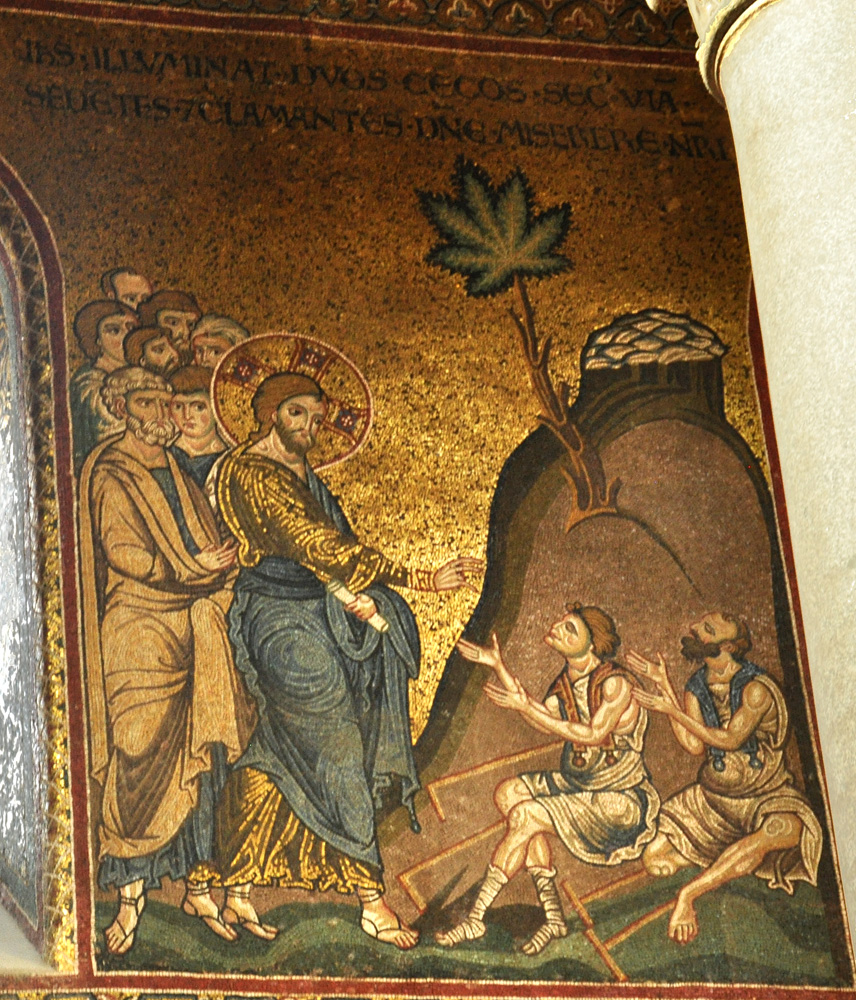
When Love Opens Our Eyes (Matthew 9:27–31)
 |
| https://www.christianiconography.info/sicily/blindmenMonreale.html |
F
So today, let Jesus ask you: “Do you believe I can do this?” Let Him touch your fears. Let Him lead. Let it be done, not according to your control, but according to your faith. Amen. Fr JM Manzano SJ
irst point to ponder is the beginning of miracles which is trust. In today’s Gospel, two blind men follow Jesus crying out, “Son of David, have pity on us!” Jesus does not heal them immediately on the road. Instead, He waits until they are inside the house and then asks a personal question: “Do you believe that I can do this?” Only when they say yes does He touch their eyes and say, “Let it be done for you according to your faith,” and their eyes are opened. Their miracle began not with sight, but with trust. Before Jesus healed their blindness, He healed their fear. Sometimes the first grace God gives us is not a change in circumstances, but the courage to let Him act.
Second point: Love Heals Our Blind Spots From Within
I once experienced my own spiritual blindness. Years ago, my mother, widowed for twenty years, shared that she had found new companionship with another widowed man. Shocked, I immediately reacted, “What will happen now to Papa?” She gently said, “Your papa is long gone.” Only then did I realize what I was really afraid of—losing the memory of my father. I feared that her new happiness would erase our precious memories together as a family. But when I met the man whom my mother loved and got to know him and his authentic love for my mother, my fears disappeared. I witnessed how deeply he cared for her, in ways my siblings and I never could. Before he came, my conversations with my mother were always full of tears and loneliness; but all of that changed when this man came, she simply found happiness again. I prayed, “Lord, thank You. You send love in ways we do not expect.”
Like the blind men, God had to lead me into the quiet “inner house” of my own heart. I realized I had been trying to impose on my mother how I thought she should live her life, almost as if my vocation as a consecrated person were also her vocation. Without noticing it, I was asking her to carry a way of life that God had not asked of her. In trying to guard her, I was actually keeping her from the love God desired for her. I finally understood that her calling was not mine to define. God was inviting her to share life with a particular person, and I needed to let her respond to that call freely.
Third Point: Faith Means Letting Go and Letting God Lead
Faith is not only believing that God can act; it is trusting how God chooses to act. The blind men did not negotiate or insist on their own terms. They let Jesus lead. Their faith was radical because they surrendered the outcome to Him.
This is what real love asks of us. Love is not control or possession; it is trusting that God cares for the other even more than we do. To love is to let go, not to cling. To let go is not abandonment, but trust. God’s love never imprisons; it always sets free.
Pope Francis reminds us in Dilexit Nos why we can love this way without fear: “He loved us first.” We do not love to earn God’s love—we love because God has already given Himself first. Letting go is not losing control; it is returning control to the One who loves better than we ever could.
Faith is not only believing that God can act; it is trusting how God chooses to act. The blind men did not negotiate or insist on their own terms. They let Jesus lead. Their faith was radical because they surrendered the outcome to Him.
This is what real love asks of us. Love is not control or possession; it is trusting that God cares for the other even more than we do. To love is to let go, not to cling. To let go is not abandonment, but trust. God’s love never imprisons; it always sets free.
Pope Francis reminds us in Dilexit Nos why we can love this way without fear: “He loved us first.” We do not love to earn God’s love—we love because God has already given Himself first. Letting go is not losing control; it is returning control to the One who loves better than we ever could.
So today, let Jesus ask you: “Do you believe I can do this?” Let Him touch your fears. Let Him lead. Let it be done, not according to your control, but according to your faith. Amen. Fr JM Manzano SJ

Comments
Post a Comment
Thank you for your interest in the above post. When you make a comment, I would personally read it first before it gets published with my response.